
Start with one progression
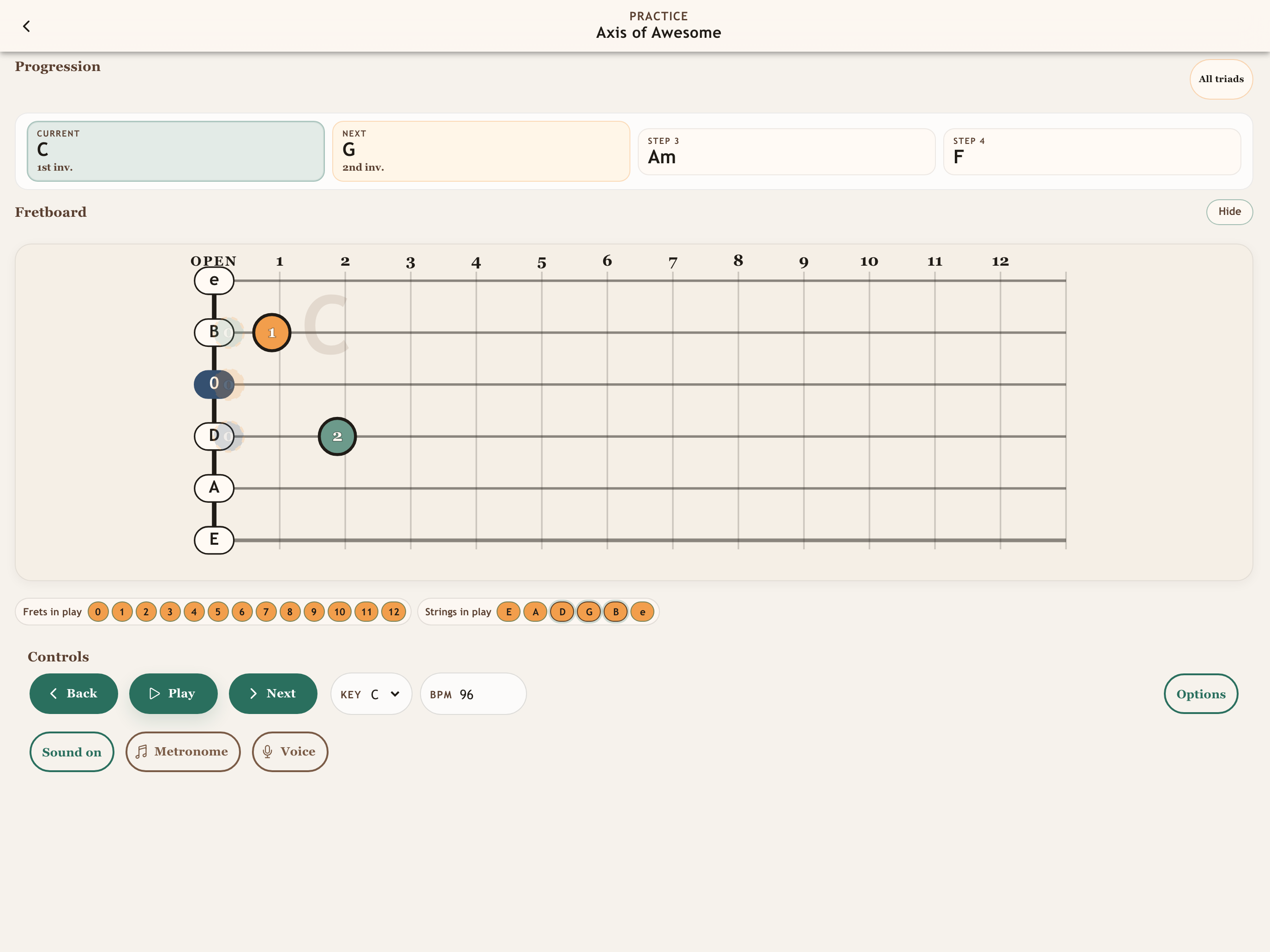
Pick a short loop before you pick a big fretboard goal. Four chords is enough. A loop like C, Am, F, G gives your ear a home base, a color change, and a return. When the chords repeat, your hand gets another chance to solve the same movement with less panic.
This is why progression-based triad practice works better than staring at a full neck chart. A chart shows everything at once. A progression gives you the next decision.


Limit the fretboard on purpose
Choose a small fret window first. Frets 3 to 7, 5 to 9, or 8 to 12 are all good starting points. The limit forces you to use nearby inversions instead of jumping to the one shape you already know.
A simple routine
- Choose a four-chord progression.
- Play one triad for each chord, staying inside a small fret window.
- Repeat the loop slowly until the movement feels predictable.
- Move the same progression to a new fret window.
Listen for the nearest move
The useful question is not always "What is the root position shape?" It is often "What nearby triad gets me to the next chord with the least movement?" That question turns inversions into musical choices.
When you can move through one progression in several fret windows, you are no longer memorizing isolated shapes. You are learning the neck as a connected system.
Practice it with a moving loop.
Guitar Triad Trainer shows the current chord, next chord, and nearby CAGED triad while the progression repeats.