
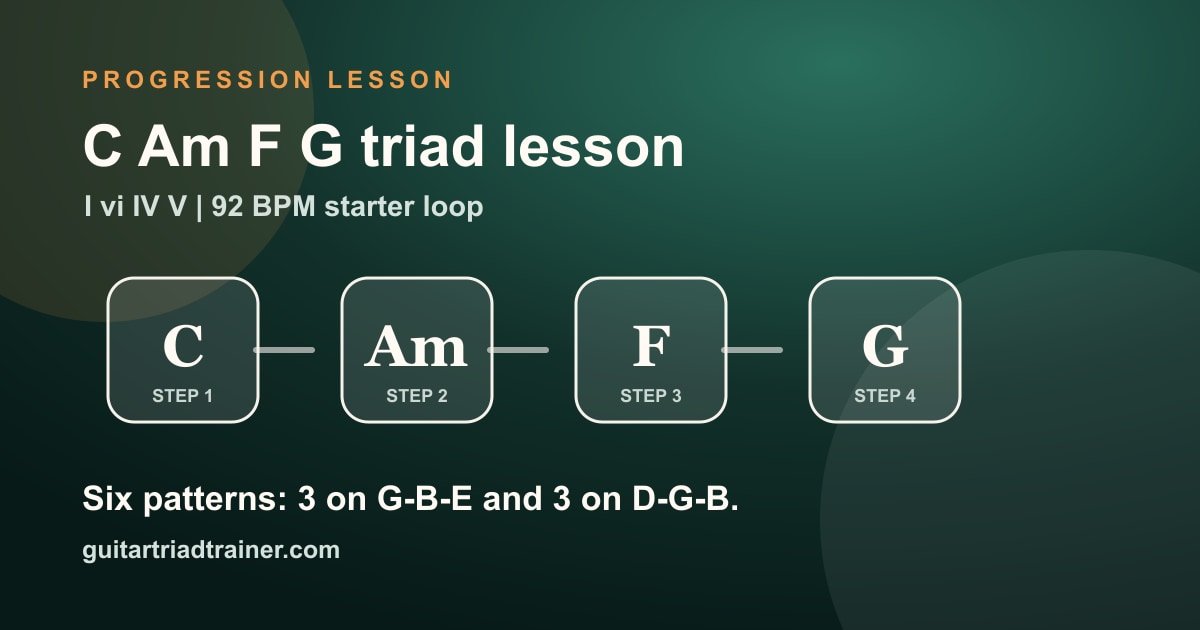
The loop
Six patterns
Play this progression three ways on G-B-E and three ways on D-G-B.
Each route starts from a different inversion, then follows the closest connected triad shapes through the same progression.
G-B-E patterns
Root-position start
Start from the root on this string set, then let the planner choose the closest next shape.
- C G5 R | B5 3 | E3 5 root
- Am G5 3 | B5 5 | E5 R 1st inv.
- F G5 5 | B6 R | E5 3 2nd inv.
- G G4 3 | B3 5 | E3 R 1st inv.
First-inversion start
Start from the third in the bass of this three-string set, then keep the next shapes nearby.
- C G9 3 | B8 5 | E8 R 1st inv.
- Am G9 5 | B10 R | E8 3 2nd inv.
- F G10 R | B10 3 | E8 5 root
- G G7 5 | B8 R | E7 3 2nd inv.
Second-inversion start
Start from the fifth in the bass of this three-string set, then follow the closest connected route.
- C G0 5 | B1 R | E0 3 2nd inv.
- Am G2 R | B1 3 | E0 5 root
- F G2 3 | B1 5 | E1 R 1st inv.
- G G4 3 | B3 5 | E3 R 1st inv.
D-G-B patterns
Root-position start
Start from the root on this string set, then let the planner choose the closest next shape.
- C D10 R | G9 3 | B8 5 root
- Am D10 3 | G9 5 | B10 R 1st inv.
- F D10 5 | G10 R | B10 3 2nd inv.
- G D9 3 | G7 5 | B8 R 1st inv.
First-inversion start
Start from the third in the bass of this three-string set, then keep the next shapes nearby.
- C D2 3 | G0 5 | B1 R 1st inv.
- Am D2 5 | G2 R | B1 3 2nd inv.
- F D3 R | G2 3 | B1 5 root
- G D0 5 | G0 R | B0 3 2nd inv.
Second-inversion start
Start from the fifth in the bass of this three-string set, then follow the closest connected route.
- C D5 5 | G5 R | B5 3 2nd inv.
- Am D7 R | G5 3 | B5 5 root
- F D7 3 | G5 5 | B6 R 1st inv.
- G D5 R | G4 3 | B3 5 root
Why this progression works
C starts settled, Am drops the harmony into a softer color, F opens the sound, and G turns everything back toward home. The changes are easy to hear, which makes the fretboard movement easier to judge.
What to practice
Listen for the shared-note feeling between C and Am, then keep F and G close enough that the turnaround feels singable.
- Play C and notice which notes can stay nearby when Am arrives.
- Choose the closest Am inversion instead of moving to a full open chord shape.
- Move from Am to F with the smallest shape change that still sounds clear.
- Use G as the turnaround chord, then return to C without resetting your hand.
Workout settings
- Strings: 3-2-1 for the first pass
- Tempo: 72 to 92 BPM
- Goal: make the turnaround feel like one connected phrase


Good search intents for this lesson
- C Am F G guitar
- doo wop progression guitar
- I vi IV V guitar
- triad inversions guitar
Practice C -> Am -> F -> G in time.
Guitar Triad Trainer keeps the progression visible, highlights the current and next moves, and helps you choose connected CAGED shapes.