
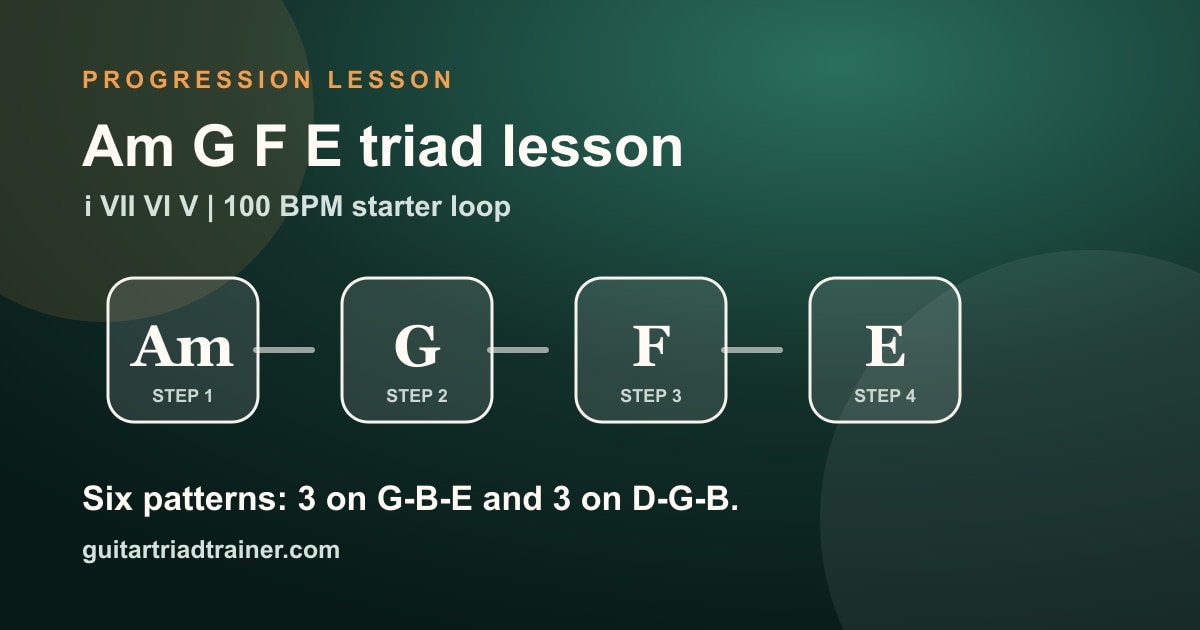
The loop
Six patterns
Play this progression three ways on G-B-E and three ways on D-G-B.
Each route starts from a different inversion, then follows the closest connected triad shapes through the same progression.
G-B-E patterns
Root-position start
Start from the root on this string set, then let the planner choose the closest next shape.
- Am G2 R | B1 3 | E0 5 root
- G G4 3 | B3 5 | E3 R 1st inv.
- F G2 3 | B1 5 | E1 R 1st inv.
- E G1 3 | B0 5 | E0 R 1st inv.
First-inversion start
Start from the third in the bass of this three-string set, then keep the next shapes nearby.
- Am G5 3 | B5 5 | E5 R 1st inv.
- G G4 3 | B3 5 | E3 R 1st inv.
- F G5 5 | B6 R | E5 3 2nd inv.
- E G4 5 | B5 R | E4 3 2nd inv.
Second-inversion start
Start from the fifth in the bass of this three-string set, then follow the closest connected route.
- Am G9 5 | B10 R | E8 3 2nd inv.
- G G7 5 | B8 R | E7 3 2nd inv.
- F G10 R | B10 3 | E8 5 root
- E G9 R | B9 3 | E7 5 root
D-G-B patterns
Root-position start
Start from the root on this string set, then let the planner choose the closest next shape.
- Am D7 R | G5 3 | B5 5 root
- G D5 R | G4 3 | B3 5 root
- F D7 3 | G5 5 | B6 R 1st inv.
- E D6 3 | G4 5 | B5 R 1st inv.
First-inversion start
Start from the third in the bass of this three-string set, then keep the next shapes nearby.
- Am D10 3 | G9 5 | B10 R 1st inv.
- G D9 3 | G7 5 | B8 R 1st inv.
- F D10 5 | G10 R | B10 3 2nd inv.
- E D9 5 | G9 R | B9 3 2nd inv.
Second-inversion start
Start from the fifth in the bass of this three-string set, then follow the closest connected route.
- Am D2 5 | G2 R | B1 3 2nd inv.
- G D0 5 | G0 R | B0 3 2nd inv.
- F D3 R | G2 3 | B1 5 root
- E D2 R | G1 3 | B0 5 root
Why this progression works
Am sets the minor mood, G and F walk downward, and E makes the return to Am feel unavoidable. The harmony feels dramatic, but the best triad path can still be small and controlled.
What to practice
Track the descending pull between chords while keeping the shape changes clean and deliberate.
- Start on Am and choose a shape that gives you room to move downward.
- Move to G without over-sliding past the nearest inversion.
- Let F continue the descent while keeping the notes clear.
- Use E as the tension chord that points back to Am.
Workout settings
- Strings: 4-3-2 or 3-2-1
- Tempo: 76 to 100 BPM
- Goal: hear the descent while staying in one connected lane


Good search intents for this lesson
- Am G F E guitar
- Andalusian cadence guitar
- minor triads guitar
- CAGED inversions
Practice Am -> G -> F -> E in time.
Guitar Triad Trainer keeps the progression visible, highlights the current and next moves, and helps you choose connected CAGED shapes.